
Introduction: Breaking the Assumption That Sustainable Packaging Must Look “Single-Colored”
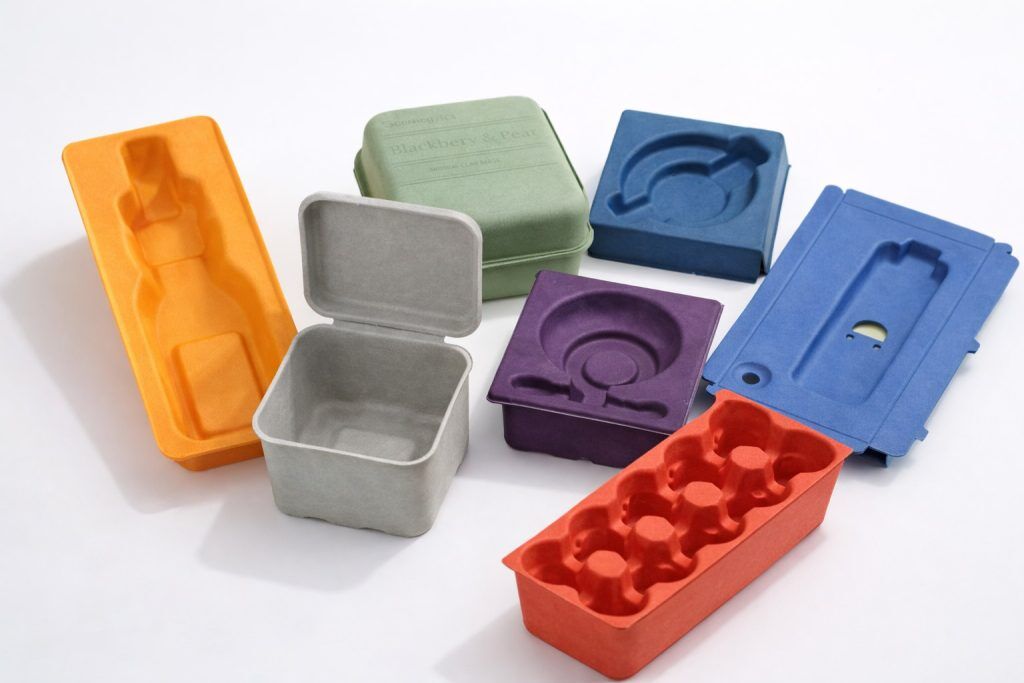
For many brands, molded fiber (molded pulp) packaging has become a natural step toward sustainability.
White, natural beige, or recycled brown tones are now widely accepted as visual signals of eco-consciousness, responsibility, and material honesty.
However, for some brands—especially in cosmetics, premium electronics, and gift-oriented products—there is still hesitation.
Not because molded fiber fails to meet functional or environmental expectations, but because it is often associated with limited visual expression.
White may feel too generic.
Recycled brown may feel too industrial.
Natural bamboo tones, while clean and refined, may still appear visually restrained for certain brand identities.
This hesitation has led some brands to assume that molded fiber packaging simply cannot support more expressive design needs.
In reality, this assumption is incomplete.
Color customization is possible in molded fiber packaging—but it works very differently from plastic, paperboard, or coated materials.
Understanding how color is achieved, what it looks like in practice, and what trade-offs it involves is essential before considering it as part of a packaging strategy.
A Core Principle: Color in Molded Fiber Is an Option, Not a Requirement
Before discussing color, it is important to establish a clear baseline.
White and natural-toned molded fiber packaging remains:
- The most widely used solution
- The most cost-efficient
- The most flexible in production
- The easiest to scale
Color customization is not a replacement for these options.
It is an extension, intended for brands that have specific visual requirements and sufficient production volume to support it.
In molded fiber packaging, color should be viewed as a design decision, not a decorative add-on—and never as a mandatory upgrade.
How Color Actually Appears in Molded Fiber Packaging

One of the most common misunderstandings is expecting molded fiber to behave like plastic when it comes to color.
Plastic packaging is typically colored by:
- Adding masterbatch pigments to a fully uniform polymer
- Producing highly saturated, perfectly repeatable tones
Molded fiber packaging follows a fundamentally different logic.
Color as a Result of Fiber Interaction
In molded fiber packaging, color is created by mixing pigments directly into the fiber slurry during the pulping stage.
The final appearance is the result of interaction between:
- Natural fibers (bagasse pulp)
- Pigment particles
- Water content and fiber density
- Forming and pressing conditions
This means:
- Color is integrated throughout the material, not applied on the surface
- The finish is naturally matte and soft
- Slight tonal variation is inherent to the material
Even when a reference color is provided, the realistic expectation is approximate matching, typically around 95% visual consistency, rather than numerical color-code precision.
This is not a flaw—it is a characteristic of natural fiber materials.
Why Some Brands Are Exploring Color in Sustainable Packaging
Visual Differentiation Without Plastic
For brands that rely on visual storytelling, color can:
- Enhance unboxing experience
- Reinforce brand mood and personality
- Improve shelf or presentation recognition
Color allows molded fiber to move beyond a purely functional role and contribute to brand expression—without reintroducing plastic or non-recyclable coatings.
Design Alignment Rather Than Exact Color Replication
In molded fiber packaging, the goal is alignment, not duplication.
Successful projects focus on:
- Matching overall tone and warmth
- Maintaining brand atmosphere
- Using color to support material texture rather than overpower it
This approach respects the nature of fiber-based materials while still allowing meaningful customization.
How Color Is Achieved: Natural Pigments and Production Logic
Natural Pigment Selection
Color customization in molded fiber relies on carefully selected pigments that are compatible with fiber-based systems.
Common categories include:
Mineral-based pigments
- High stability
- Suitable for muted, neutral, or darker tones
- Better consistency across batches
Plant-based pigments
- Derived from renewable sources
- Visually blend well with natural fibers
- Produce softer, more organic color impressions
The choice depends on both aesthetic goals and performance expectations.
Pulp Dyeing vs. Surface Coating

Color in molded fiber is typically achieved through in-pulp dyeing, not surface coating.
This method offers several advantages:
- Uniform color throughout the part
- No risk of peeling or flaking
- Clean edges and consistent cross-sections
- No impact on recyclability or compostability pathways
Compared to surface coatings, in-pulp dyeing maintains material integrity and supports long-term durability.
Safety and Compliance Considerations
When properly selected and controlled, pigments used in molded fiber packaging:
- Comply with FDA and EU food-contact requirements
- Are free from heavy metals
- Do not compromise compostability or recyclability
However, it’s important to understand that the process of coloring molded fiber products does have some environmental impact that differs from producing white or natural-toned products.
For instance, the pulping process for colored products involves dyeing fibers in large slurry tanks, which requires additional water for rinsing and cleaning.
This cleaning process can result in wastewater that, if not properly managed, may have a higher impact on the surrounding ecosystem compared to non-dyed fibers.
Some brands also consider this potential ecological effect when evaluating colored molded fiber as an option, particularly in areas where environmental impact is a critical concern. The additional environmental footprint during the production stage is one of the trade-offs to consider when choosing color over natural tones.
Key Considerations for Brands:
- Wastewater and Eco Impact: The dyeing process requires more water and cleaning resources, which may increase the environmental impact of production.
- Eco-Conscious Decision-Making: Brands that prioritize a holistic approach to sustainability may need to account for the environmental impact of the dyeing process when choosing color customization for molded fiber packaging.
How Different Industries Approach Colored Molded Fiber Packaging
Cosmetics and Personal Care

Brands often prefer:
- Soft, low-saturation tones
- Muted pinks, warm greys, sage greens
- A tactile, calming aesthetic
Color is used subtly, supporting the product rather than drawing attention away from it.
Premium Electronics

Color choices tend to be restrained:
- Charcoal
- Deep grey
- Soft black tones
These colors enhance perceived weight and precision while maintaining a clean, technical feel.
Gift and Seasonal Packaging

Color can be used to:
- Reflect seasonal themes
- Create limited-edition differentiation
- Add emotional warmth without excessive decoration
In these cases, color works best when combined with structural design rather than surface graphics.
The Practical Reality: Why Colored Molded Fiber Costs More
This section is critical for setting realistic expectations.
Color Means Production Commitment
Unlike white or natural pulp, colored pulp cannot be easily switched on and off.
When a color is introduced:
- An entire pulping tank is dedicated to that color
- A full production line runs only that color during the cycle
This reduces production flexibility and increases planning complexity.
System Cleaning and Downtime
After producing colored pulp:
- Residual pigment remains in pipes, pumps, and tanks
- Thorough system cleaning is required before switching colors
Cleaning takes time and results in unavoidable downtime—an operational cost that must be absorbed.
Higher Quality Requirements and Scrap Rates
Colored molded fiber reveals imperfections more clearly.
Even minor contamination or tiny dark particles become highly visible once color is introduced.
As a result:
- Mold surface quality requirements are higher
- Cleanliness standards are stricter
- Scrap rates are typically higher than for white or natural products
This reflects higher production standards, not inefficiency.
Volume and Capacity Utilization
If order volumes are insufficient to:
- Keep a production line running continuously
Then:
- Equipment sits idle
- Capacity is underutilized
- Overall production efficiency decreases
This is why colored molded fiber packaging typically requires:
- Higher minimum order quantities
- Higher unit pricing
The cost reflects production reality—not added margins.
Sampling, Development Time, and Expectation Management
Color development in molded fiber is not instant.
Due to fiber absorption behavior:
- Multiple sampling rounds may be required
- Visual evaluation is essential
- Adequate development time must be planned
Brands considering color should treat it as a collaborative design process, not a quick specification exercise.
Compostability and End-of-Life Considerations
Color does not automatically disqualify molded fiber packaging from composting or recycling.
When:
- Pigments are properly selected
- Fiber composition remains unchanged
Colored molded fiber can still meet home compostable and industrial compostable requirements.
Clear communication and correct labeling remain essential.
Conclusion: Expanding Possibilities Without Replacing the Baseline
White and natural-toned molded fiber packaging remains the most practical, scalable, and widely adopted solution—and will continue to be so.
Color customization does not replace this foundation.
It simply expands the design vocabulary available to brands that need more visual flexibility.
When used thoughtfully, color can:
- Enhance perception
- Support brand identity
- Respect the nature of fiber-based materials
The key is understanding both the possibilities and the limits.
Interested in exploring whether colored molded fiber packaging makes sense for your brand, volume, and design goals?
We’re happy to share recent color development samples and discuss realistic expectations—before any commitment is made. Contact us today!