
5 Essential Questions to Ask During Initial Supplier Discussions
The global shift toward sustainability is no longer a trend—it is a mandatory transition for brands that want to remain relevant. According to recent market data, the molded pulp packaging market is expected to reach over $7 billion by 2030, driven by the urgent need to replace single-use plastics with biodegradable alternatives. However, as demand surges, so does the number of suppliers entering the field. For procurement managers, the challenge has shifted from “where can I find pulp?” to “how do I find a supplier who won’t fail me during mass production?
Part I: Why “Professional Experience” is the Soul of Molded Pulp
There is a common misconception in the packaging industry: that molded pulp is a “plug-and-play” technology where you simply buy a machine and start producing. In reality, molded pulp is a sophisticated art form that requires a delicate balance of water chemistry, fiber physics, thermal dynamics, and structural engineering.
Breaking the Industry Myth
Many clients transition to eco-friendly packaging only to face a “prototyping nightmare.” They receive a perfect sample, but the mass-produced order arrives with dimensional deviations, inconsistent colors, or structural weaknesses that cause product damage. This happens because the supplier lacks the Engineering Mindset required to translate a creative concept into a stable, high-volume manufacturing process.
The InNature Pack Positioning
At InNature Pack, we distinguish ourselves as more than just a “contract manufacturer.” We are an engineering-driven partner. Our focus is on the 1:1 restoration capability—ensuring that the physical product delivered to your warehouse matches the 3D digital design perfectly. We don’t just sell boxes; we provide the “certainty” that your packaging will perform exactly as intended.
Part II: 5 Essential Questions to Ask During Initial Supplier Discussions
To separate the “hobbyists” from the “masters,” you need to ask deep, operational questions that reveal the factory’s technical maturity.
Question 1: How do you determine the material ratio (e.g., Bagasse vs. Recycled Pulp) for my specific product?

Why you must ask: The raw material is the DNA of your packaging. It dictates the strength, aroma, cleanliness, and premium feel of the final tray. A supplier who offers a “one-size-fits-all” pulp usually lacks an understanding of your product’s specific needs.
The Deep Dive:
- Source Stability: Inquire about their procurement channels. Do they have long-term contracts with pulp mills, or do they buy whatever is cheapest on the spot market? Inconsistent pulp leads to “brittle” batches that crack under pressure.
- The Professional Logic: A professional supplier should offer a strategy. For example, is ideal for high-end cosmetics due to its smooth finish and lack of odor, while recycled pulp is a cost-effective choice for industrial heavy-duty parts.
- Consistency Control: Ask how they manage batch consistency. At InNature Pack, we monitor fiber purity to ensure that even with recycled materials, the structural integrity remains identical across thousands of units.
Question 2: If my product has deep recesses or irregular shapes, how do you ensure structural protection?
Why you must ask: Most clients aren’t experts in “draft angles”—the technical slope required to pull a part out of a mold. What they do care about is whether the packaging will cradle their product securely.
The Deep Dive:
- Strategic Ribbing: Instead of focusing on why a shape is “hard to make,” a professional supplier discusses Ribbing (strengthening structures). They should explain how they distribute these ribs to absorb shock and prevent the tray from collapsing.
- 3D Engineering vs. Guesswork: At InNature Pack, we utilize advanced 3D CAD modeling. Even if you don’t have a physical prototype of your product, we can use your 3D files to create a digital “perfect fit,” identifying potential weak points before the first mold is even cut.
- Technical Reference: You can see how these designs are brought to life in our guide.
Question 3: How do you help us avoid “Mold Modification Fees” before mass production begins?
Why you must ask: Tooling is the biggest upfront investment in custom packaging. “Modification fees” are the industry’s hidden trap—small changes to a metal mold can cost thousands and delay your launch by weeks.
The Deep Dive:
- The 1:1 Resin Prototype: Ask if they offer a 3D-printed resin sample. At InNature Pack, we provide high-precision resin prototypes that allow you to test the fit with your actual product before we touch the metal tooling. This stage solves 99% of dimensional issues.
- Transparent Tooling Logic: Be wary of “free tooling” promises, which often hide poor-quality molds.
- Dry Press vs. Wet Press: Ensure they clearly explain which process fits your budget and aesthetic goals, as is significantly more complex and precise.
Question 4: How is Quality Control (QC) performed, and what is your policy for shipping damage?

Why you must ask: Molded pulp production is a “natural” process; machines can sometimes miss small burrs, black spots, or slight warping. If a factory relies 100% on automated sensors, defects will slip through.
The Deep Dive:
- Manual Full-Inspection: While we use modern equipment, InNature Pack insists on a manual inspection process. Our workers personally check every piece to remove items with surface imperfections or “fuzzy” edges.
- The “3-Per-Thousand” Security Policy: This is our signature commitment. We know that international shipping can be unpredictable. To ensure your production line never stops, we include 0.3% (3 per 1000 units) of free spare parts with every order. If you order 100,000 units, we ship 100,300 to account for any potential transit damage. This is how we provide true peace of mind.
Question 5: How do you control the timeline from design approval to the first sample?
Why you must ask: Delays in the sampling stage are a massive red flag. If a factory takes a month just to show you a prototype, your mass production will likely be a logistical disaster.
The Deep Dive:
- The 18-Day Promise: At InNature Pack, our standard is 18 days from the final 3D design approval to the delivery of physical molded pulp samples.
- Proactive Problem Solving: A professional engineering team will find faults in your 3D file during the consultation phase, not after the mold is made. This “communication speed” is what separates a world-class supplier from a basic factory. You can learn more about how to choose the right molded pulp packaging for your product to ensure it meet your brand standards.
Part III: Beyond Technology – The “Invisible Assets”
When you visit a factory, look past the shiny machines. Pay attention to the details that signal a culture of quality.
- Trade Flexibility: Does the factory understand global logistics? A reliable partner should be comfortable with various Incoterms, whether you need EXW (Ex Works) for your own forwarder, or a “hassle-free” DDP (Delivered Duty Paid) where the packaging arrives directly at your door.
- The “Senses” Test: Observe the sample room. Does the pulp have a strange chemical smell? Are the edges smooth to the touch, or are they sharp and poorly finished? A factory that respects the craft will produce that is vibrant and consistent, not dull and patchy.
- Communication Initiative: A “pure OEM” factory waits for your instructions. An Engineering Partner provides solutions. If they see a way to save you money by nested shipping or structural optimization, they should speak up.
Part IV: Conclusion – Choosing a Long-Term Engineering Partner
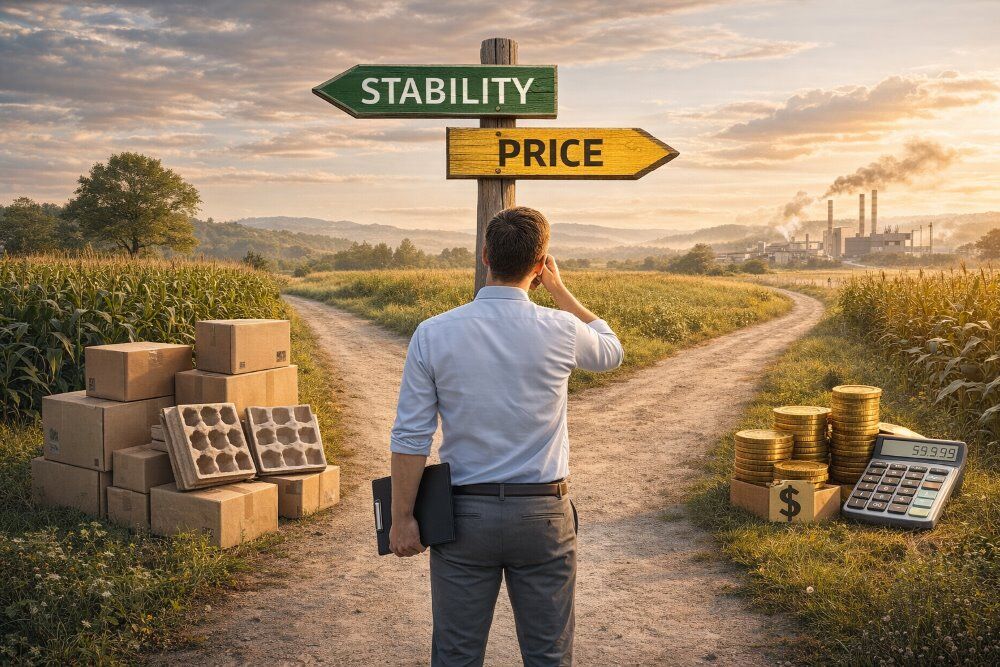
In the world of custom sustainable packaging, choosing a supplier isn’t about finding the lowest unit price—it’s about finding the lowest total risk. A cheap tray becomes very expensive if it damages your product, delays your launch, or ruins your brand’s unboxing experience.
At InNature Pack, we provide the “Green Safe Harbor” for your transition. By combining high-precision 3D engineering, a transparent 5-step workflow, and our industry-leading spare parts policy, we ensure that your leap into molded pulp is a successful one.
Are you ready to find the perfect fit for your product? Contact the InNature Pack engineering team today for a 3D structural consultation. Let’s build a packaging solution that protects your product as much as it protects the planet.