
In the poultry industry, where margins are often razor-thin and operations run 24/7, packaging is rarely just “packaging.” For large-scale egg producers, distributors, and international traders, the humble 30-egg tray—often referred to as an egg flat—is a critical component of the supply chain.
The choice you make regarding this seemingly simple molded pulp product ripples through your entire operation. A sub-standard tray leads to higher breakage rates during transit. An inefficiently designed tray unnecessarily inflates your ocean freight and warehousing costs. And a supplier with inconsistent output can bring your automated packing line to a grinding halt.
Facing a global market with fluctuating feed prices and environmental pressures, procurement managers cannot afford to view egg flats as a simple commodity. So, when evaluating a partner, what should you actually look for? This guide moves beyond the surface to explore the critical benchmarks of a high-quality, cost-efficient 30-egg tray supplier.
1. Production Capacity and Supply Chain Resilience: The Foundation of Trust
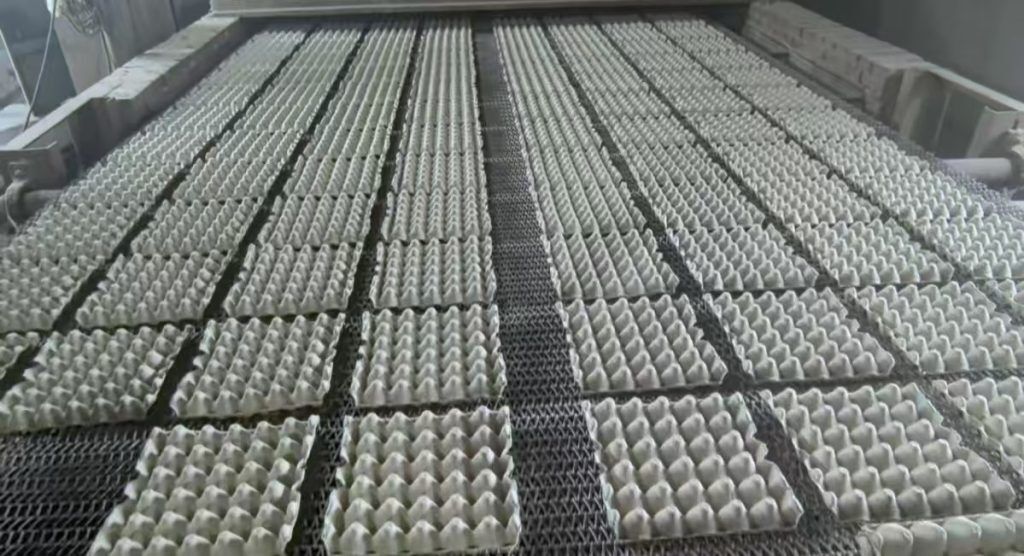
The first, and perhaps most critical, question you must ask a potential supplier is not “What is your price?” but “What is your actual daily output?”
The first rule of poultry logistics is simple: Hens don’t wait. Production is continuous, and your packaging supply must be equally relentless. If your supplier fails to deliver on time, eggs pile up, and your operational flow breaks. A supplier’s production capacity is a direct proxy for their reliability and their ability to absorb your risk.
The Danger of Small-Scale Suppliers
Small-to-medium manufacturing facilities might offer attractive initial pricing, but they often lack the resilience needed for industrial-scale procurement. When they secure a large order from another client, your delivery gets pushed back. If one of their few machines breaks down, your supply chain collapses.
Setting the Industrial Benchmark
For large operations, you need a supplier whose capacity vastly exceeds your average daily need, providing a critical buffer for peak seasons or unexpected demand spikes. We believe the industry benchmark for a true strategic partner should be a dedicated facility capable of producing around 800,000 units per day. This level of industrial scale doesn’t just guarantee volume; it ensures that your largest orders can be fulfilled rapidly, and “Fast Delivery” becomes a reality, not just a marketing slogan.
Furthermore, high capacity is almost always synonymous with high automation. Fully automated forming and drying lines ensure that the first egg tray produced on Monday is identical to the last one produced on Sunday. This dimensional consistency is paramount if you are using automated denesters and packing robots. A deviation of just a few millimeters in a tray’s flange can cause a machine to jam, leading to expensive downtime.
2. Engineering for the “Cold Chain” and Humidity
A tray that looks sturdy in a dry showroom might fail miserably in a real-world shipping container. One of the most overlooked factors in choosing a supplier is how their pulp formula reacts to moisture.
The Condensation Challenge
Egg trays often move from cool packing rooms to warm loading docks, or travel through humid tropical climates. This creates condensation. Standard molded pulp acts like a sponge; it absorbs moisture, loses its structural rigidity, and eventually buckles under the weight of the stack.
The “Water-Resistant” Advantage
Top-tier suppliers don’t just sell one type of tray. They offer technical solutions like Water-Resistant (Waterproof) versions. By integrating eco-friendly waterproofing agents into the pulp during the manufacturing process, suppliers like InNature Pack produce flats that remain rigid even in high-humidity environments.
When interviewing a supplier, ask: “Can you customize the pulp formula for high-moisture resistance?” If the answer is no, your eggs are at risk the moment they leave your facility.
3. Logistics Math: Turning “Air” into Profit

In international trade, you aren’t just paying for egg trays; you are paying for the space they occupy in a container. If your supplier hasn’t optimized their tray’s nesting depth, you are essentially paying to ship air.
The Efficiency Gap
Let’s look at the industry standard vs. a logistics-optimized design:
- The Average Supplier: Typically fits around 85,000 to 95,000 trays in a 40ft HC container.
- The Optimized Benchmark: A precision-engineered design allows for 112,320 trays per 40ft HC.
The Financial Impact
Achieving a load of 112,320 units represents a roughly 20% increase in shipping efficiency. For a high-volume buyer, this means:
- Lower Per-Unit Cost: Your landed cost per tray drops significantly.
- Reduced Carbon Footprint: Fewer containers mean a more sustainable supply chain.
- Warehousing Savings: Trays that stack tighter occupy less physical floor space in your warehouse.
Always ask for a Loading Plan before signing a contract. If they can’t fit over 110,000 units in a 40ft HC, they are costing you money every time a ship leaves the port.
4. The Color Strategy: Balancing Aesthetics and MOQs

We often receive requests for vibrant, colorful egg flats—yellows, greens, and purples. While these can look great, a professional supplier must be honest about the trade-offs involved in color customization.
The Reality of “Custom Color” Orders
Coloring molded pulp is a massive industrial undertaking. It requires flushing the entire system, adding expensive pigments, and dealing with significant material waste during the transition. Because of this:
- High MOQs are Mandatory: For colored trays, the Minimum Order Quantity is usually much higher to justify the machine downtime.
- Increased Unit Price: Dyes and cleaning labor add a premium to the cost.
Why “Standard” is Often Smarter
For 90% of commercial applications—wholesale, transport, and foodservice—the most cost-efficient and fastest strategy is to stick with high-competition standard colors:
- Natural Light Brown (Recycled Kraft)
- Grey-White
Why choose these?
- Price Leadership: These colors offer the most competitive pricing because they require the least amount of chemical processing.
- Lead Time: Because these are our primary production colors, they are almost always available for immediate dispatch.
- Eco-Professional Look: These colors signal a “natural” and “sustainable” product to the end consumer.
At InNature Pack, we provide high-quality colored trays for those who need them, but we always advise our clients to consider Natural Light Brown or Grey-White first to maximize their ROI and maintain supply chain agility.
5. Structural Integrity: Protection is Non-Negotiable
A tray that is “cheap” is the most expensive tray you can buy if it leads to breakage.
What to look for in the physical tray:
- Pillar Strength: The vertical posts must be rigid. If they can be easily pinched or collapsed by hand, they won’t survive a 10-pallet stack.
- Surface Smoothness: Rough trays can cause micro-cracks in eggshells through vibration. High-quality molding results in a smoother finish that protects the egg’s surface.
- Denesting Consistency: If you use an automated packing line, the trays must separate (denest) perfectly every time. Trays that “stick” together lead to sensor errors and line stoppages.
6. Environmental and ESG Compliance
The global market is moving away from plastic. A supplier’s commitment to sustainability is no longer “nice to have”—it’s a requirement for doing business with major retailers.
- 100% Biodegradable: Ensure the trays are made from recycled paper pulp with no plastic additives.
- Sustainable Sourcing: Look for suppliers who can demonstrate a clean, ethical supply chain.
- Waste Management: Does the factory recycle its own water? Do they use energy-efficient drying systems? These factors affect the long-term viability of your partner.
Final Checklist: How to Vet Your Next Supplier
When you are ready to evaluate potential partners, use this checklist to ensure they can meet the demands of a modern supply chain:
- Capacity & Speed: Does their daily output provide enough of a buffer to handle my peak seasons and emergency orders?
- Logistics Efficiency: How many units can they realistically fit into a 40ft HC container? (Look for benchmarks above 110,000).
- Environmental Adaptability: Do they offer a water-resistant version for cold chain or humid transit?
- Color & Cost Management: Which of their colors are most price-competitive, and what are the MOQs for custom-dyed trays?
- Technical Consistency: Can they guarantee dimensional accuracy for my automated packing equipment?
Conclusion: Strategic Partnership vs. Spot Buying
Choosing the right 30-egg tray supplier is a balancing act between price, protection, and performance. While many vendors focus only on the price per unit, the most successful procurement managers look at the “Total Cost of Ownership.”
At InNature Pack, we believe in engineering supply chain advantages. Whether it’s our high daily output that secures your supply, or our optimized container loading that slashes your freight costs, we are here to help you scale.
Are you looking to optimize your next shipment? Contact our team today to discuss how our egg flats solutions can fit your operational needs.