
In the bustling aisles of a modern retail store, the “first moment of truth” happens in seconds. A customer glances at a shelf, and their eyes are immediately drawn to products at eye level, neatly suspended on hanging displays. For decades, this “pegboard” real estate has been dominated by plastic blister packaging. It’s clear, it’s cheap, and it has that convenient little hole at the top.
But times have changed. Today, the “convenience” of plastic is being overshadowed by its environmental cost. As a business owner or a packaging manager, you’ve likely noticed a significant shift: your clients aren’t just asking for sustainable materials; they are demanding retail-ready, plastic-free solutions that can go straight from the shipping box to the display hook.
At InNature Pack, we’ve seen a surge in inquiries for molded pulp trays that feature hanging holes. The question we often get is: “Can paper pulp really replace the functionality and look of a plastic hanging pack?” The answer is a resounding yes. In this guide, we’ll explore why this shift is happening, which industries are leading the charge, and—most importantly—the three different ways we can engineer hanging holes into your sustainable trays to fit your brand’s unique needs.
The Retail Revolution: Why Plastic-Free is the New Standard
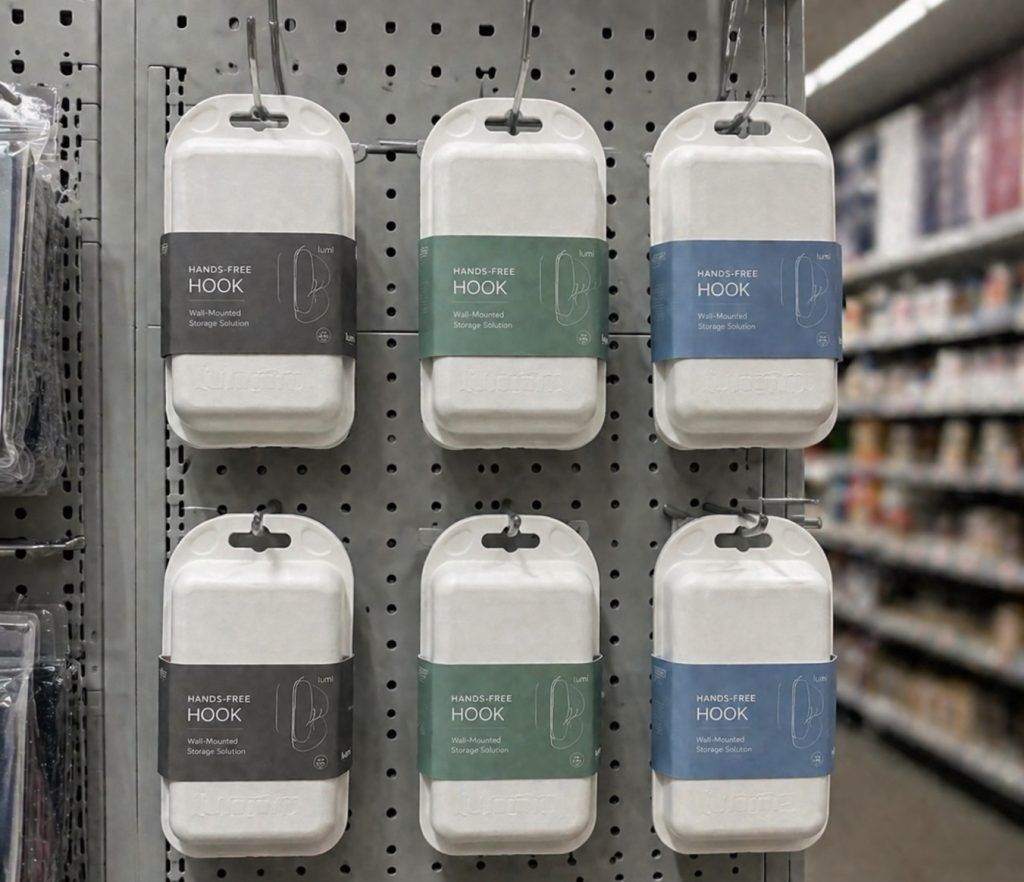
The move away from plastic isn’t just a “nice-to-have” marketing buzzword; it’s a commercial necessity. Global retailers are setting hard deadlines for plastic reduction.
According to recent industry data, the global sustainable packaging market is projected to grow from $329.51 billion in 2025 to over $476.16 billion by 2032. This growth is fueled by a massive consumer shift: recent surveys indicate that 84% of consumers now prefer paper-based packaging over plastic, and nearly 37% have already switched brands specifically because of packaging concerns.
Major retailers like Walmart and Target have implemented “sustainable packaging playbooks,” pushing suppliers to eliminate non-recyclable plastics. If your product is still encased in a plastic blister, you’re not just risking a “greenwash” label—you might be risking your shelf space.
Who is Moving to Sustainable Hanging Trays?
We’ve seen a diverse range of products successfully transition to molded pulp trays with hanging holes. If you deal with any of the following, this solution is for you:
- Personal Care: Razors, manual or electric toothbrushes, and grooming kits.
- Beauty & Skincare: Nail polish sets, specialized skincare vials, blush compacts, and lip balms.
- Consumer Electronics: Earbuds, charging cables, and small digital accessories.
- Stationery: Premium pens, markers, and specialized office tools.
- Small Accessories: Phone cases, keychains, and lifestyle merchandise.
These products all share a common trait: they are lightweight enough to be hung, and they benefit immensely from a packaging material that feels “organic” and “premium” to the touch.
Beyond Eco-Friendly: 4 Strategic Reasons Clients Choose Hanging Pulp Trays
Why are brands specifically requesting the “hanging hole” feature for their pulp trays? Beyond the obvious goal of attracting customers and saving shelf space, there are four deep-seated business reasons:
1. Omnichannel Readiness (Simplifying Your SKU)
In today’s market, most products are sold both online and in physical stores. A molded pulp tray with a hanging hole is the ultimate “hybrid.” It serves as a protective shipping insert (cushioning the product inside a box for E-commerce) and a retail display (ready to hang on a pegboard in a store). This dual-functionality allows brands to use the same packaging design for all channels, drastically reducing SKU complexity and inventory costs.
2. Enhanced Durability and Security
One common concern with paper-based hanging tabs is that they might tear. However, molded pulp is inherently fibrous and tough. Compared to traditional cardstock hooks, a molded pulp hanging hole offers superior tear resistance. For slightly heavier items—like an electric toothbrush set or a complete skincare kit—molded pulp provides the structural integrity needed to ensure the product stays safely on the hook without falling or sagging.
3. Premium Tactile Experience & Brand Value
Packaging is a silent salesman. The natural, earthy texture of sugarcane bagasse or bamboo fiber creates an immediate “organic” and “high-end” psychological trigger for consumers. When combined with a clean, precisely punched hole, the packaging feels intentional and premium. In the beauty and office stationery sectors, this tactile quality significantly justifies a higher price point for the product inside.
4. 100% Mono-material: Frictionless Recycling
Modern consumers hate “mixed material” packaging that requires them to peel off plastic hooks before recycling. By integrating the hanging hole directly into the pulp tray, you create a 100% mono-material solution. The entire package can be tossed directly into the paper recycling bin. This “frictionless” recycling experience aligns perfectly with global “easy-to-recycle” labeling trends and builds long-term brand loyalty.
3 Ways to Create the Perfect Hanging Hole
Not all hanging holes are created equal. Depending on your budget, your production volume, and the “vibe” of your brand, we typically recommend one of three methods:
Option A: Independent Attached Hooks (The “Premium” Approach)

In this method, we produce small, high-density pulp hooks as separate pieces, which are then manually or semi-automatically bonded to the main tray.
- The Look: It creates a distinct, sophisticated “layered” look. Because the hook is a separate component, it stands out from the main box, giving the packaging a more engineered, high-end feel.
- Best For: Premium brands that want their packaging to feel like a piece of art. If your product sits in the high-end gift or luxury beauty category, this “extra” touch of quality is often worth the slightly higher assembly cost.
Option B: In-Mold Formed Holes (The “Eco-Value” Choice)

This is the most direct method. We design the hole directly into the forming mold. When the pulp is pressed and dried, the hole is already there.
- The Look: The edges are slightly rounded and have the natural, soft texture of molded pulp.
- Best For: Brands that want a “raw and organic” aesthetic. If you can accept a larger hole size (like a standard circular or “Euro-hole”) and don’t mind a bit of natural fiber texture around the edges, this is the most cost-effective and efficient way to go. It requires no extra steps and zero manual labor.
Option C: Post-Press Punching (The “Precision” Solution)

This is where technology meets aesthetics. We first produce the solid tray, and then use a high-precision punching mold to cut the hole out in a separate post-press step.
- The Look: Flawless. The edges are as sharp, clean, and professional as if they were cut from high-grade cardstock or plastic. There is zero “fuzziness” or “burrs.”
- Best For: Electronics and high-end cosmetics. If your product needs to compete directly with the “clean-cut” look of traditional plastic blisters, punching is the way to go. While it requires a one-time investment in a punching mold, the visual result is indistinguishable from high-end retail standards.
Design Tip: Finding the Right Balance
A common mistake is designing a hanging hole that looks “uncoordinated” with the rest of the package. At InNature Pack, we always advise our clients to keep the Proportion Principle in mind.
A tiny package shouldn’t have a massive hole that dwarfs the product, and a larger tray needs a hole with enough “structural shoulder” (the space between the hole and the top edge) to ensure it doesn’t tear under the product’s weight. Our engineers usually recommend a distance of at least 15-20mm from the top edge to the hole center for maximum durability.
Conclusion: Let Your Brand Stand Tall (and Green)
Switching to plastic-free packaging doesn’t mean sacrificing your presence on the retail shelf. By incorporating cleverly designed hanging holes into your molded pulp trays, you can maintain your visibility while significantly boosting your brand’s “green” credentials.
At InNature Pack, we don’t just make boxes; we create sustainable experiences. Whether you need the cost-efficiency of in-mold forming or the razor-sharp precision of punching, we are here to help you navigate the transition.
Quick Poll: What is your biggest concern?
When you consider switching your packaging from plastic to molded pulp, what is the primary factor that makes you hesitate?
- A. Cost (Initial mold investment or unit price)
- B. Aesthetic Appeal (Will it look as “clean” as plastic?)
- C. Durability & Strength (Will the hanging hole hold up on the shelf?)
Not sure which direction to take? Welcome to contact us! Our team is ready to help you evaluate your specific product needs and provide a tailored assessment to help you find the perfect balance between sustainability and retail performance.
Contact InNature Pack for a Free Packaging Assessment