
When reviewing a molded pulp packaging sample, most buyers first check whether the product fits. Then they look at the surface, the shape, and often the edges. Why does one tray have a neat cut outline while another has a slightly fibrous rim? Does every tray need trimming?
For dry-pressed recycled pulp packaging, edge finishing is a choice worth discussing during development. At InNature Pack, three options we consider are hot-pressed flanges, molded-in flanges, and conventional edge trimming. Each offers a different balance of appearance, edge strength, and processing cost.
Understanding these differences helps you specify the finish you actually need and avoid paying for an extra operation that may add little value to your application.
1. Hot-Pressed Flanges: A Neater Profile Without Separate Trimming
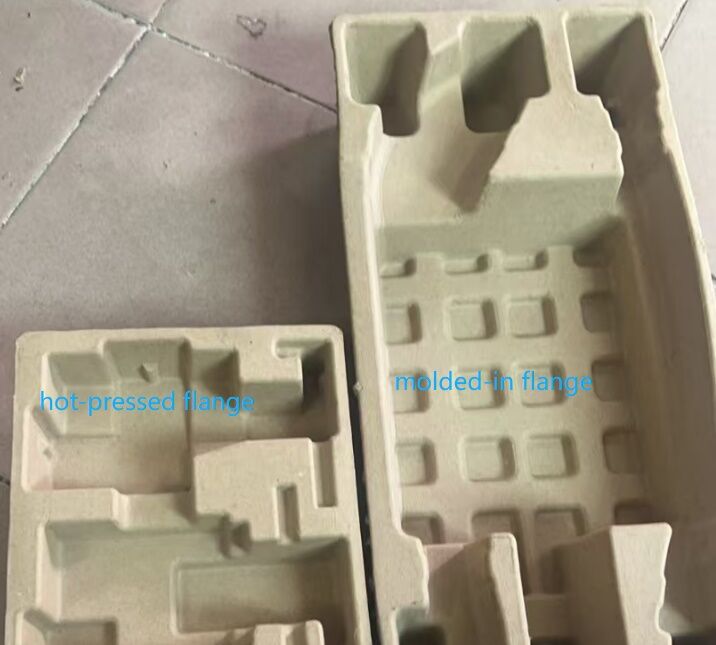
With this option, the flange is shaped during the hot-pressing stage, without a separate edge-trimming operation.
Of the two untrimmed options discussed here, hot-pressed flanges generally have a neater overall profile. They can be a practical choice when you want the packaging to look reasonably tidy while keeping processing costs under control.
However, a hot-pressed flange should not be confused with a cut edge. Slight fiber burrs may remain along the perimeter. Whether these are acceptable depends on your visual standards and how the packaging will be used.
For example, an insert inside a shipping carton may not need the same edge finish as packaging displayed directly to a customer. Even for a visible insert, a small amount of edge roughness may be acceptable once you have reviewed a physical sample.
Skipping trimming removes one production operation and can reduce processing costs slightly. The actual saving should be confirmed in the quotation for your design.
2. Molded-In Flanges: More Material at the Edge for Greater Strength

A molded-in flange takes shape during the forming stage. The edge is designed to collect pulp, building up material in this area.
In the options we offer, this produces a stronger edge than the hot-pressed flange approach. It is worth considering when edge strength matters more than achieving the neatest possible untrimmed outline.
The trade-off is appearance. Molded-in flanges generally have a less tidy profile than hot-pressed flanges, and slight fiber burrs can remain. Buyers should therefore be comfortable with the edge finish before approving production.
Like hot-pressed flanges, this approach avoids a separate trimming operation and can slightly lower processing costs.
It is important to keep the strength comparison specific: a stronger flange does not automatically mean the entire package has better cushioning or can carry more weight. Those qualities still depend on the complete design and should be assessed with the actual product.
3. Trimmed Edges: A Cleaner, More Defined Outline

Conventional edge trimming uses a separate operation to remove excess material around the perimeter, creating a cleaner and more clearly defined outline.
This option is useful when the customer has stricter requirements for edge appearance or does not want the slight burrs associated with an untrimmed finish. For packaging that is clearly visible during presentation or unpacking, that extra attention to the outline may be worthwhile.
Trimming adds processing and cost, so it helps to identify what the operation needs to achieve. Are you looking for a tidier visible edge? Does a particular area need excess material removed? An agreed requirement gives the manufacturer a clearer target than simply asking for a “better finish.”
Trimming improves the cut outline; it does not change the texture of the entire tray. A dry-pressed recycled pulp part will still have its characteristic fiber surface.
4. How the Three Options Compare
| Consideration | Hot-pressed flange | Molded-in flange | Trimmed edge |
|---|---|---|---|
| Edge treatment | Shaped during hot pressing | Formed with pulp build-up at the edge | Excess perimeter material is cut away |
| Separate trimming required | No | No | Yes |
| Appearance | Neater of the two untrimmed options | Less tidy than hot-pressed flanges | Cleaner, more defined outline |
| Slight edge burrs | May remain | May remain | Perimeter excess is removed by cutting |
| Edge strength | Assess against the design requirements | Stronger than the hot-pressed flange option described here | Depends on the remaining edge structure |
| Processing cost | Can save the trimming operation | Can save the trimming operation | Includes an additional operation |
All three options can be designed to work with an outer box. An untrimmed edge does not automatically prevent a close fit. Box fit depends on the dimensions, edge geometry, and allowance built into the packaging design.
Choosing the Right Finish for Your Project
Start with what matters in use. If a slightly fibrous edge is acceptable, both untrimmed options are worth evaluating. If you prefer a neater profile without adding trimming, a hot-pressed flange may suit the project. If edge strength is the priority, consider the molded-in flange.
Where appearance requirements are stricter, compare a trimmed sample with the untrimmed alternatives. Seeing the difference in the actual packaging context is often more useful than judging an enlarged close-up alone.
Cost should be considered alongside these requirements. Removing one operation can offer a modest saving, but it does not guarantee that every untrimmed design will be cheaper than every trimmed design. Compare quotations for the proposed solutions, especially if their structures or material usage differ.
The useful question is: does trimming give this package an improvement that your application needs?
Agree on the Edge Finish Before Tooling and Production
Discuss the edge treatment while the design and quotation are being prepared. This gives both sides a chance to align the structure, appearance expectations, and processing route before tooling is finalized.
Close-up photographs are helpful for explaining the options, but physical samples provide a better basis for final approval. Check the edge appearance, handle the flange, and place the insert inside its intended box with the product loaded.
Where slight burrs are acceptable, agree on a reference sample rather than relying only on words such as “smooth” or “tidy.” A shared visual reference makes expectations much easier to communicate.
Finding the Right Balance
Hot-pressed flanges offer a neater untrimmed profile, molded-in flanges provide stronger edges through pulp build-up, and conventional trimming creates a cleaner outline. The right choice depends on which qualities matter most to your packaging.
At InNature Pack, we can help you compare these options for your custom dry-pressed recycled pulp packaging. Send us your product drawing or photos, outer box dimensions, and edge appearance requirements, and we can recommend an approach for your project.