
Molded pulp packaging can be used for many chilled and frozen products, including fruit, vegetables, meat, frozen soup cups, and temperature-controlled shipments. However, describing a package as simply “freezer safe” does not tell buyers very much.
A molded pulp tray may remain stable in a freezer but soften after condensation forms during unloading. Another design may perform well around sealed frozen cups but fail when exposed to liquid from thawing meat. A fruit tray may need ventilation for efficient cooling, while a cold-chain insert used with gel packs may need protection from prolonged contact with moisture.
For custom molded pulp packaging, temperature is therefore only one part of the evaluation. Moisture exposure, storage time, product weight, stacking pressure, secondary packaging, and temperature changes throughout distribution all affect the final result.
What Actually Changes in a Cold-Chain Environment?
Low temperatures do not automatically make molded pulp packaging unusable. In many applications, moisture is the more important concern.
Cold-chain packaging may be exposed to high humidity, frost on the product, condensation caused by temperature changes, or liquid released during thawing. Because molded pulp is fiber-based, absorbing moisture can reduce its stiffness and compression strength. The extent of that change depends on the material, forming process, package thickness, structural design, exposure time, and whether a barrier treatment is used.
The package may also pass through several different environments. It could be packed at room temperature, placed in a freezer, transported in a refrigerated vehicle, unloaded into warmer air, and then returned to cold storage. Each temperature change can create additional condensation.
This is why a single freezer test does not always represent the real application. The more useful question is not simply, “Can molded pulp withstand −18°C?” It is, “Can this specific molded pulp design continue to protect this product throughout its actual cold-chain journey?”
Different Cold-Chain Products Require Different Packaging Designs
Cold-chain products do not all expose their packaging to the same conditions. The design should begin with the product and packing method rather than with a general assumption about frozen packaging.
Frozen Soup Cups
For frozen soup, molded pulp is usually used as a cup carrier, divider, or protective insert rather than as the primary container holding the liquid.
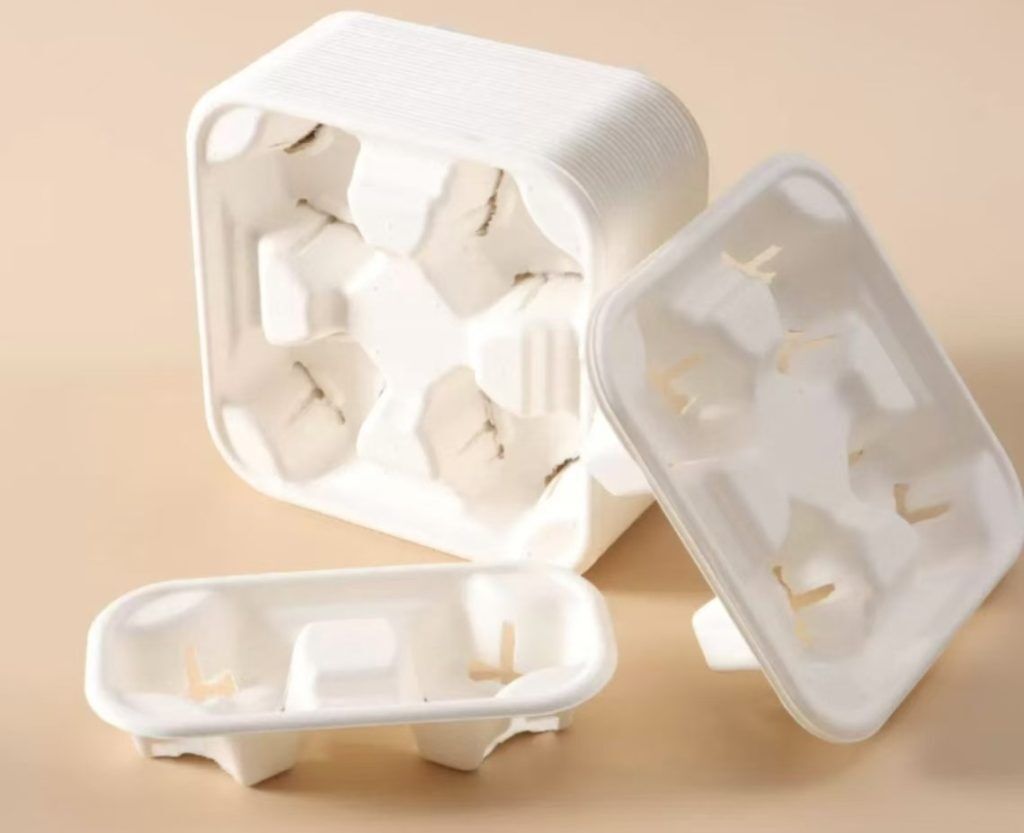
A custom tray can keep multiple cups separated, distribute their weight, and reduce movement inside the shipping bag or carton. The design should support stable areas of the cup without applying unnecessary pressure to the lid, rim, or sidewall. If four heavy cups are arranged in one tray, the base also needs enough stiffness to prevent bending during lifting and handling.
The main moisture risks may come from frost on the cup surfaces, condensation during temperature changes, or leakage around the lid. A tray that remains dry inside a freezer may behave differently after being carried into a warmer environment. Testing should therefore include both the frozen condition and the period after removal from storage.
If the molded pulp tray is enclosed in an outer bag, the bag can provide additional moisture protection. However, the tray still needs to maintain sufficient strength if condensation becomes trapped inside the bag.
Chilled or Frozen Meat
Meat packaging can present a more demanding moisture challenge because the package may encounter water, fat, blood, or liquid released during thawing.
The first question is whether the molded pulp will directly contact the meat. A direct-contact meat tray must be evaluated for food-contact compliance, liquid resistance, hygiene, and compatibility with any sealing film or absorbent pad. It may require a suitable barrier solution, but the barrier must be selected according to the actual food, temperature, and storage time.
The requirements are different when molded pulp serves as secondary packaging around meat that is already sealed in a bag or film. In this case, the pulp component may primarily provide positioning, cushioning, separation, or stacking support. Nevertheless, it may still be exposed to condensation or leakage from damaged primary packaging.
Deep channels may appear useful for collecting liquid, but they can also hold water against the fiber for longer periods. The structure should instead be designed around the expected source and amount of moisture, as well as the way the pack will be stored and transported.
Fruits and Vegetables
Fresh produce packaging must balance protection, ventilation, moisture control, and stacking strength.
Fruit and vegetables can release moisture and heat, and some products need airflow during precooling, refrigerated storage, and transportation. Packaging and stacking patterns can materially affect airflow, heat exchange, and moisture conditions around produce.
Ventilation holes can help cold air circulate, but adding more openings is not always better. Large or poorly positioned openings may weaken the tray, reduce stacking strength, or leave delicate produce exposed to pressure from adjacent packs. The openings should be designed together with the outer carton and the stacking arrangement so that airflow is not blocked after packing.

Drainage features may also be useful if the produce is washed before packing or if moisture is likely to collect during distribution. At the same time, the tray should avoid sharp contact points that could bruise berries, tomatoes, peaches, or other delicate products.
Fresh, chilled, and frozen produce should not be treated as one identical application. Fresh berries may require ventilation and gentle support, while individually quick-frozen fruit packed inside a sealed bag may mainly need an outer molded pulp insert for grouping and transport protection. The right structure depends on how the product is prepared and where the pulp component sits within the complete packaging system.
Cold-Chain Shipping Components
Molded pulp can also be used as an insert, divider, end cap, bottle holder, or cushioning component inside a temperature-controlled shipping box.
In these applications, the package may not touch the food at all. Its job is to stop movement, separate products, absorb impacts, and maintain the arrangement of the shipment. This makes molded pulp suitable for more than conventional food trays.
However, refrigerants introduce additional design questions. Gel packs, ice packs, frozen bottles, or insulated box walls may create condensation. If water collects at the bottom of the carton, the lower pulp component may be exposed for much longer than the upper insert. Placing gel packs directly against an untreated pulp wall may also produce a different result from separating them with a liner or sealed pouch.
A custom design should identify where moisture is likely to form and where the highest loads will occur. The goal is not necessarily to make every surface waterproof. It is to ensure that the complete packaging system retains adequate protection under its expected conditions.
Direct Food Contact and Secondary Packaging Are Not the Same
A molded pulp component used around a sealed cup or pouch does not face the same requirements as a tray that directly holds meat, fruit, or another unpackaged food.
Direct food-contact packaging needs to be assessed according to the food type and intended conditions of use. Frozen and refrigerated storage are also recognized as specific conditions when evaluating food-contact materials. In addition to material compliance, buyers may need to consider grease resistance, liquid absorption, hygiene, sealing performance, and the length of contact.
Secondary packaging is more focused on mechanical protection. It may still need moisture resistance, but its primary functions could be cushioning, separation, positioning, and load distribution.
Making this distinction early prevents unnecessary cost. A non-contact shipping insert may not need the same barrier treatment as a direct-contact meat tray. Conversely, a standard untreated insert should not automatically be presented as suitable for direct food contact simply because it performs well in cold storage.
Dry-Pressed or Wet-Pressed Molded Pulp?
Both dry-pressed and wet-pressed molded pulp can be considered for cold-chain projects, but they serve different priorities.
Dry-pressed molded pulp is often chosen for produce trays, cup carriers, transport inserts, and other applications where cost, cushioning, and higher-volume production are important. It normally has one relatively smooth side and one rougher side, with a more traditional fiber-packaging appearance.
Wet-pressed molded pulp offers smoother surfaces, more refined details, and generally tighter dimensional control. It may be more suitable when the insert is part of the retail presentation, when the product requires a precise fit, or when the packaging needs a more premium appearance.
However, a smoother and denser wet-pressed surface should not automatically be described as waterproof. Likewise, choosing dry-pressed pulp does not mean that the package cannot be used in a cold environment.
The decision should consider appearance, tolerances, protection requirements, expected quantity, tooling budget, moisture exposure, and the role of the component within the overall pack.
Is a Moisture-Resistant Coating Necessary?
A coating or barrier treatment may be useful when molded pulp will directly contact moist food, thawing liquid, grease, persistent condensation, or a wet refrigerant. It may also be considered when the package must maintain relatively high strength after extended exposure to humidity.
But “water-resistant,” “grease-resistant,” and “waterproof” do not mean the same thing. A treatment that handles brief condensation may not withstand pooled liquid for several days. Resistance to vegetable moisture does not automatically prove suitability for fatty meat or soup leakage.
Adding a coating can also affect cost, recyclability, compostability, sealing compatibility, and food-contact requirements. It should therefore solve a defined problem rather than being added as a default feature.
In some applications, changing the complete packing arrangement may be more practical. For example, separating a pulp insert from a gel pack with a liner, improving drainage, or keeping the primary container securely sealed could reduce moisture exposure without coating the entire molded part.
Structural Design Becomes More Important When Pulp Gets Damp
A well-designed molded pulp package does not rely on material thickness alone.
Ribs, curves, flanges, support columns, and changes in section depth can help the package resist bending and distribute loads. Support points should follow stronger areas of the product, while fragile surfaces should be given clearance. Broad unsupported panels should be avoided where the insert must carry heavy frozen products.
The designer should also consider how vertical loads move through the packed carton. When trays are stacked, strong areas should align where possible so that the weight is transferred through stable sections instead of through delicate products or weak pulp walls.
For cold-chain applications, this structure should not be evaluated only when completely dry. If moisture exposure is expected, the package needs enough safety margin to remain functional after some loss of stiffness. That does not necessarily mean using more fiber everywhere. Often, improving the geometry is more effective than simply increasing the overall wall thickness.
Evaluate the Entire Cold-Chain Journey
Packaging development should reflect what happens before, during, and after cold storage.
The evaluation may begin with the temperature of the product during packing. It should then consider freezing or precooling, storage time, stacking height, handling, transportation, temperature fluctuations during transfer, retail display, home delivery, and possible thawing.
The package may be required to perform different functions at different stages. A frozen soup tray may need to carry weight without bending during packing, keep cups separated during transportation, and remain easy to handle after condensation forms. A fruit tray may need to allow airflow during cooling and then resist compression when stacked. A cold-chain shipping insert may need to hold products away from refrigerants while surviving vibration and drops.
Looking at only the lowest temperature can miss the stage where failure is most likely.
What Information Does a Packaging Supplier Need?
To evaluate a custom cold-chain project, the supplier should understand the product dimensions, weight, packing arrangement, storage temperature, and maximum storage time. It is also important to know whether the pulp will directly contact food and whether it may encounter condensation, grease, water, blood, thawing liquid, or refrigerants.
The outer carton dimensions, number of products per carton, stacking requirements, transportation method, and any existing bags, cups, films, or liners should be shared as well. Buyers should also clarify their expectations for water resistance, grease resistance, recyclability, compostability, surface appearance, and printing.
These details help determine whether the project is better suited to dry-pressed or wet-pressed pulp, whether a barrier is necessary, and which conditions should be included in prototype testing.
Conclusion
Molded pulp packaging can support many cold-chain applications, from fruit and meat trays to frozen cup carriers and protective shipping inserts. But no single material or structure is automatically suitable for every product below 0°C.
The real performance of the package depends on the combination of temperature, moisture, time, product weight, stacking pressure, and distribution conditions. By considering these factors during structural design and validating the complete pack under realistic conditions, businesses can develop molded pulp packaging that offers both practical protection and a fiber-based alternative to conventional packaging.
Developing custom molded pulp packaging for frozen foods, fresh produce, meat products, or cold-chain shipping? Share your product dimensions, packing method, storage conditions, and expected order quantity with InNature Pack. We can help assess the appropriate material, structure, and testing plan for your application.