
Choosing an insert is not simply a matter of selecting a material. The insert must hold the product securely, manage shocks during transportation, fit efficiently into the outer box, and work with the customer’s packing process. Cost, order volume, storage space and presentation may also influence the decision.
Molded pulp and corrugated inserts are two widely used paper-based options. Both can reduce reliance on plastic packaging, and both can provide effective protection when designed correctly. However, they achieve that protection in different ways.
Corrugated inserts are created mainly by cutting, folding and interlocking flat sheets of corrugated board. Molded pulp inserts are formed into three-dimensional shapes using dedicated molds. This basic structural difference affects almost every part of the packaging project, from product positioning and assembly time to tooling costs and design flexibility.
Neither option is automatically better for every application. The right choice depends on the product, the expected order volume, the distribution environment and the way the complete packaging system is assembled and used.
What Are Molded Pulp Inserts?
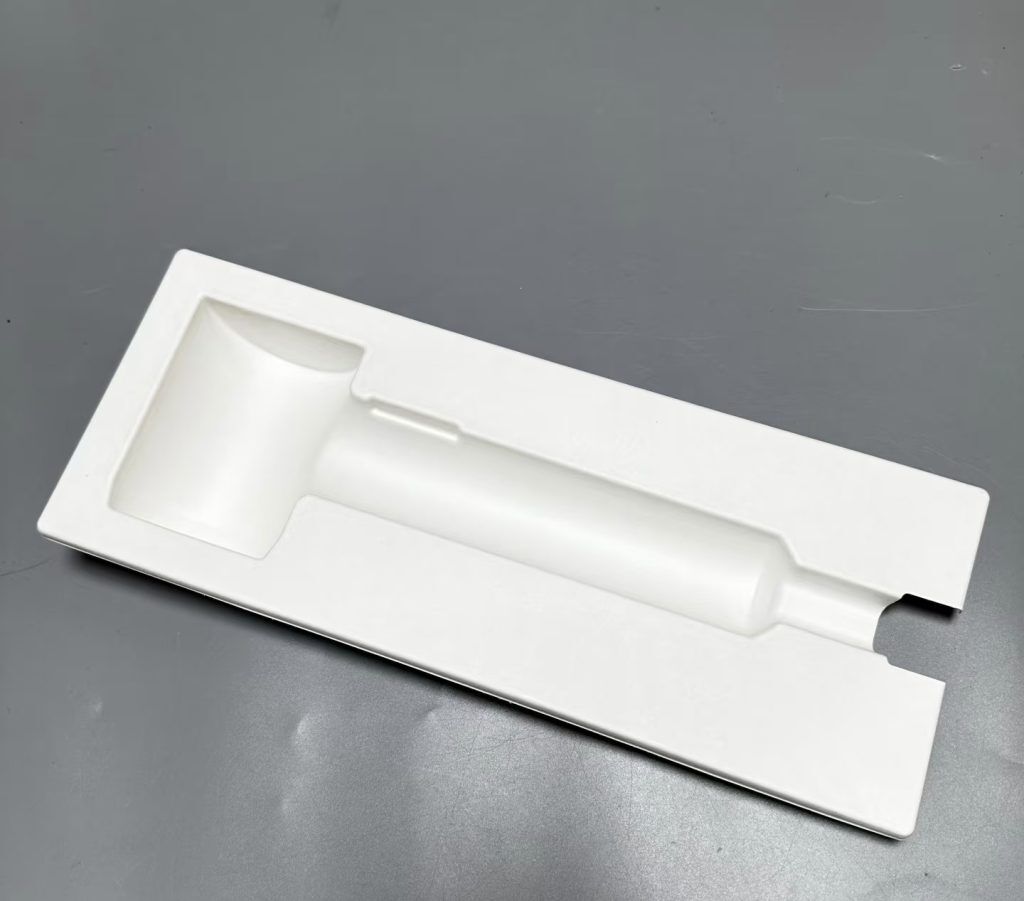
Molded pulp inserts are three-dimensional packaging components made by forming pulp slurry over a specially designed mold. Depending on the application, they can be produced from recycled paper, bagasse, bamboo pulp or other fiber-based materials.
A molded pulp insert can follow the general shape of a product and include multiple functional features within one component. These may include product cavities, positioning ribs, supporting surfaces, finger-access areas, accessory compartments and stacking features.
There are also different molded pulp production processes. Dry-pressed molded pulp generally has a more natural and textured surface and is commonly used for protective and industrial packaging. Wet-pressed molded pulp has a smoother, more refined appearance and can be suitable for cosmetics, consumer electronics and other products where presentation is an important part of the packaging.
Because the structure is molded rather than folded, designers have more freedom to create curves, varying depths and support features in different directions. However, custom molded pulp packaging normally requires tooling, and its design must follow the practical requirements of the forming process.
What Are Corrugated Inserts?
Corrugated inserts are made from corrugated board that is die-cut and then folded, slotted, interlocked or glued into the required shape. Common designs include dividers, folded end caps, layered pads, partitions and more complex suspension structures.
Corrugated inserts are particularly effective for products with regular dimensions and clearly defined surfaces. A rectangular device, boxed component or group of bottles, for example, may be secured using folded walls and partitions without the need for a three-dimensional molded cavity.

Although corrugated inserts are often described as simple folded packaging, they can also be highly engineered. A well-designed corrugated insert can create controlled gaps around the product, reinforce vulnerable areas and keep the item suspended away from the outer carton walls.
Their main advantage during product development is flexibility. A cutting die generally costs less than a molded pulp production mold, and the structure can often be revised more easily if the product or box dimensions change.
Product Fit and Positioning
Molded pulp has a clear advantage when a product has curved, irregular or detailed contours. The insert can be shaped around selected parts of the product and provide support in several directions.
This does not mean every surface should be tightly wrapped. Effective packaging usually supports a product at carefully selected locations while leaving sufficient space for controlled movement or deformation during an impact. The ability to create those three-dimensional support points is one of the main reasons molded pulp is frequently used for bottles, personal care products, electronics, medical devices and irregular industrial components.
It is also useful for sets containing several items. A single tray can include separate cavities for a main product, accessories, cables, applicators or instruction materials. This helps keep the contents organized and provides a consistent presentation when the package is opened.
Corrugated inserts rely more heavily on straight folds, slots and flat supporting surfaces. They work especially well for square or rectangular products, products already packed in individual cartons, or multiple items that can be separated by partitions.
More complex positioning is possible with corrugated board, but it may require several folded pieces. As the number of components and folds increases, assembly becomes more complicated and the chance of inconsistent setup on the packing line may also increase.
For a simple, regular product, that extra complexity may be unnecessary. A well-designed corrugated structure could provide all the required positioning at a lower initial development cost. Molded pulp becomes more compelling when the product shape or packing arrangement makes a flat-folded solution difficult to manage.
Cushioning and Impact Protection
It is tempting to assume that an insert that fits the product more closely will always provide better shock protection. In practice, fit and cushioning are related but not identical.
A protective insert must manage the energy generated when a package is dropped, shaken, stacked or handled roughly. If an insert is too rigid or supports the product at the wrong locations, impact forces may be transferred directly to a fragile component. If it is too weak, the product may move excessively or contact the outer carton.
Molded pulp structures can be designed with ribs, angled walls, raised supports and controlled deformation areas. These features can help hold the product away from the box walls and absorb energy when the package experiences an impact. Thickness, fiber composition, product weight and the available cushioning distance all affect the final performance.
Corrugated inserts manage impact through different structural methods. Folded layers, fluted board, reinforced corners and suspension gaps can all contribute to cushioning. For regular products, corrugated end caps can provide effective protection without following every detail of the product’s surface.
The outer box also plays an essential role. Even a carefully designed insert may fail if the carton is too weak, excessively large or unable to withstand the expected stacking conditions. Similarly, a strong carton cannot compensate for an insert that allows the product to move into an unprotected position.
This is why material comparison alone cannot determine which solution will pass a transport test. The complete package should be evaluated using test conditions appropriate to the actual product and distribution risks. Not every project needs the same test program, but fragile, heavy or high-value products generally require more careful validation than lightweight, low-risk items.
Packing and Assembly Efficiency

Packaging cost does not end with the purchase price of the insert. The time required to prepare each package can become significant when thousands of units are packed every day.
A molded pulp insert is generally delivered as a finished three-dimensional component. The packing operator can place it into the carton, load the product and continue to the next step. Features such as product cavities and accessory positions are already formed, which helps make the process consistent across different workers and production shifts.
This “pick and place” convenience can be particularly valuable when a corrugated alternative would require several folds or interlocking sections. Eliminating those steps can reduce packing time, training requirements and assembly errors.
However, not every corrugated insert is slow to assemble. A simple divider may take only seconds to install. Some inserts can be supplied pre-glued, and automated or semi-automated equipment can form certain structures efficiently. The real comparison therefore depends on the specific design and the customer’s packing setup.
A practical evaluation should consider how many packaging components are required, how long each option takes to assemble, whether special instructions are needed and how easily the operator can tell if the insert has been assembled correctly.
For a small order packed manually, a few extra seconds may not matter. On a high-volume packing line, the same difference can become an important labor and productivity cost.
Tooling Cost, Order Volume and Design Flexibility

Custom molded pulp packaging normally requires a mold to form the part. Depending on the process and project requirements, separate sample tooling and mass-production tooling may be used. Additional tools may also be required when the part needs precise cutting or another secondary operation.
This creates a higher initial investment than most corrugated insert projects. The investment makes more commercial sense when the product design is stable and the expected order volume is sufficient to distribute the tooling cost over many units.
For example, a company preparing a long-term product line with regular annual orders may value the repeatability, customized positioning and packing efficiency of a molded pulp solution. A startup still changing its product dimensions may view the same mold investment as premature.
Corrugated inserts normally require a cutting die, although very early samples may sometimes be cut digitally without formal tooling. This makes corrugated board practical for pilot launches, low-volume products and projects that may undergo frequent revisions.
Changes are usually easier as well. Adjusting a fold line, slot position or panel dimension may require updating the cutting file and die. Changes to a molded pulp insert can be more involved, particularly if they affect the overall dimensions, cavity depth, molding direction or product arrangement.
This does not mean molded pulp designs cannot be modified. Small adjustments may be possible, depending on the mold structure. However, buyers should finalize the product dimensions and key packaging requirements as much as possible before approving production tooling.
Storage, Shipping and Packing-Line Space
Molded pulp inserts are commonly designed to nest inside one another. Nesting can reduce the space between parts and make storage more efficient than stacking fully separated three-dimensional trays.
The actual nesting ratio, however, varies considerably. Draft angles, insert depth, undercuts, ribs and supporting structures all influence how closely the parts can be stacked. A shallow tray may nest very efficiently, while a deep insert with complicated features may retain considerable volume.
Corrugated inserts have a different logistical advantage: they can often be transported and stored flat. Before assembly, large quantities can occupy relatively little space. This can make corrugated inserts highly efficient for inbound freight and warehouse storage.
Once formed, however, corrugated structures may require substantially more room. A customer therefore needs to consider where the inserts will be assembled and whether there is enough space beside the packing line to hold formed components.
Molded pulp normally arrives ready to use, so no separate folding area is needed. Its three-dimensional volume may increase incoming freight, but it can simplify material handling at the packing stage.
The fairest comparison considers the complete flow of packaging materials: freight to the packing facility, warehouse storage, internal movement, assembly space and line-side inventory. It is not accurate to claim that molded pulp always takes less space simply because it is nestable, just as it is not accurate to assume flat corrugated inserts create no operational space requirements.
Appearance and the Unboxing Experience
Protective inserts are sometimes hidden inside industrial shipping cartons, but in consumer packaging they may be immediately visible when the box is opened. In those cases, appearance becomes part of the product experience.
Molded pulp can create a unified presentation because several functional features are integrated into one continuous form. A wet-pressed insert can offer a relatively smooth surface, defined edges and a refined appearance suitable for cosmetics, electronics and gift sets. Embossed or debossed logos can also be incorporated into the mold, allowing branding without requiring a separate printed label.
Dry-pressed molded pulp has a more textured finish. For many brands, that natural fiber appearance supports the desired packaging message. It can also be appropriate for industrial products where surface refinement is less important than protection and cost.
Corrugated inserts tend to have a more structural and functional appearance, but they do not have to look basic. Board color, visible flute type, printing and thoughtful fold design can all improve presentation. Corrugated board can also coordinate well with an outer box to create a consistent paper-based packaging system.
The appropriate level of finish depends on where the customer sees the insert. A protective component inside a bulk industrial carton does not need the same surface quality as an insert holding a premium skincare set.
Sustainability and End-of-Life Considerations
Both molded pulp and corrugated inserts can support a move away from plastic foam or thermoformed plastic trays. Both are predominantly fiber-based and may be recyclable where suitable paper recovery systems are available.
Still, “paper-based” should not automatically be treated as proof that one option has a lower overall environmental impact.
Material weight matters. A complicated packaging design that uses much more fiber than necessary may not be the best choice simply because the material is paper. Freight volume, manufacturing waste, the origin of the fiber and the number of packaging components should also be considered.
The use of coatings, films, adhesives, labels and other added materials may affect how easily either insert can enter a paper recycling stream. If moisture, grease or surface performance requires a treatment, its function and end-of-life implications should be assessed for the intended market.
Molded pulp can be produced from different fiber sources, including recycled paper, bagasse and bamboo. The best material depends on the required surface, color, strength, application and compliance requirements. A natural-looking fiber is not automatically more sustainable than another option in every market.
Corrugated packaging can also contain a high proportion of recovered fiber and benefits from established recycling systems in many regions. Its ability to ship flat may reduce freight volume, while a molded pulp insert may reduce the number of components or replace a difficult-to-recycle plastic tray.
A credible sustainability comparison should therefore focus on the actual packaging design rather than broad claims such as “100% sustainable” or “zero impact.”
Cost Comparison: Look Beyond the Unit Price
The quoted unit price is important, but it does not show the total cost of using an insert.
A molded pulp part may require a higher tooling investment but reduce assembly labor. A corrugated insert may have a lower development cost but require several pieces and more time to fold. One option may use less warehouse space, while the other may reduce packaging mistakes or product damage.
A complete cost review should include:
- Insert price and the number of components required
- Mold or cutting-die investment
- Minimum order quantity
- Freight and storage volume
- Folding and assembly labor
- Packing-line productivity
- Product damage and return risk
- Costs associated with future design changes
The lowest insert price does not always produce the lowest total packaging cost. At the same time, operational savings should not be assumed without measuring the actual design. Comparing prototypes and recording assembly time can provide more useful information than relying on general material claims.
When Should You Choose a Molded Pulp Insert?
Molded pulp is often a strong option when the product has complex curves, irregular geometry or several vulnerable areas that require three-dimensional support. It is also useful when multiple components need to be organized within one tray.
Projects with stable designs and recurring medium or high order volumes are generally better positioned to absorb the tooling investment. Molded pulp may also be preferred when reducing assembly steps, achieving consistent product positioning or creating a more integrated unboxing experience is important.
It is particularly worth considering when the current packaging uses plastic trays or foam components and the brand is looking for a customized fiber-based alternative.
When Is a Corrugated Insert the Better Choice?
Corrugated inserts are often more practical for rectangular products, individually boxed items and shipping arrangements that can be secured with dividers or folded supports.
They are also well suited to pilot orders, low-volume products and projects that are still changing. The lower initial development cost reduces the risk of investing in a mold before the product design and sales volume are stable.
Corrugated board may also be preferable when flat storage is a priority and the packing facility already has the labor or equipment needed to form the inserts efficiently.
Selecting corrugated packaging in these situations is not a compromise. It may simply be the more appropriate engineering and commercial decision.
Can Molded Pulp and Corrugated Packaging Be Used Together?

In many projects, the most effective solution uses both materials.
A molded pulp insert can position the product, support fragile areas and provide local cushioning. The corrugated outer carton can protect the full package during handling and provide stacking strength in storage and transportation.
Additional corrugated pads or dividers may also be used around a molded pulp insert when a product is heavy, unusually fragile or packed with other components. In some designs, molded pulp end caps protect the product while the corrugated carton maintains the required distance from the outer walls.
This is why an insert should not be developed in isolation. Its external dimensions, support positions and deformation space must work with the outer carton and the packed product.
Quick Comparison
| Factor | Molded Pulp Inserts | Corrugated Inserts |
|---|---|---|
| Product positioning | Strong three-dimensional fit for complex shapes | Effective for regular shapes and flat supporting surfaces |
| Cushioning approach | Molded ribs, supports and controlled deformation areas | Folds, layers, flutes and suspension structures |
| Packing process | Usually supplied ready to use | May require folding, interlocking or gluing |
| Initial investment | Custom tooling is normally required | Usually requires only a cutting die or digital sampling |
| Low-volume suitability | Less economical for many custom projects | Often practical for small or pilot orders |
| Design changes | Major changes may require mold modification or replacement | Usually faster and less expensive to revise |
| Incoming storage | Nestable but still three-dimensional | Highly compact when stored flat |
| Presentation | Integrated form with natural or refined surface options | More structural, with appearance enhanced through board and print choices |
| Typical applications | Irregular products, multi-item sets and stable-volume programs | Regular products, low-volume launches and frequently revised packaging |
Which Insert Is Better for Your Product?
There is no universal winner between molded pulp and corrugated inserts.
Molded pulp is often better suited to products that require three-dimensional positioning, integrated compartments, consistent packing and a distinctive fiber-based presentation. Corrugated inserts are often more suitable when the product is regular in shape, the initial quantity is small, the design may change or flat storage is especially important.
Most importantly, protection should be evaluated at the level of the complete package. The insert, product and outer box must work together under the expected handling, storage and transportation conditions.
If you are deciding between a molded pulp insert and a corrugated solution, send InNature Pack your product dimensions, weight, fragile areas, current packaging and estimated order volume. Our team can evaluate whether a custom molded pulp insert is suitable for your project and help you develop a structure for further sampling and testing.